Thursday, September 30, 2021

"That's why I became a vegetarian"

When it is discovered that I am a vegetarian (okay, flexitarian, which I will explain later), inevitably someone asks me why I adopted the diet. The truth is, it happened kind of accidentally and gradually. Initially, vegetarian options on menus seemed more appealing, then later, cooking vegetables was easier and quicker than making meat-laden meals. It wasn't until I read Eating Animals by Jonathan Safran Foer that I started thinking about food as a choice. So I'd say the question more important than why I started the diet is why I persist with it. 

A lot of my reasons are based on information in Foer's book, which addresses the common rationales of ethics, environment, and health. Although I try to stay fit, I think it's pretty clear that third category has little influence on me; I mean, I can eat a whole bag of fully plant-based Doritos in one sitting. The other two categories play a role, but perhaps not in the traditional way one might think. For me, everything comes back to pain. 

The most common pain discussed in relation to diet is the pain of animals. A long line of research supports the fact that animals experience physical pain and possibly emotional distress when being killed, which is why European and American institutions provide guidance and guidelines for humane slaughtering. I, for one, never had to be scientifically convinced of this fact. Based on how much it hurts to just bump your elbow at the wrong place, I figured most animals wouldn't enjoy being murdered. It's more a matter of whether you can morally justify causing pain to animals in order to sustain yourself. Many would say that avoiding this pain, simply by not eating animals, would be the obvious ethical choice. But that presumes that plants don't feel pain, which hasn't been proven. In fact, some research supports the fact that trees thrive based on a form of ecological dependence that indicates social awareness. It's not a giant leap from intelligence that involves an ability to communicate to one that includes a sense of pain, especially when you consider how much we are still learning about plant consciousness. Just the other day, scientists discovered a new carnivorous plant -- which is suggesting many plants might not even be vegetarians! So basically, if any food I eat will bear pain by my doing so, the ethical argument for vegetarianism based on animal pain becomes moot.

Then there is the argument about pain for humans involved in animal slaughter. Both crop and meat processing are connected to physical pain: long hours performing repetitive and strenuous actions, possibly in unsanitary or unsafe conditions, takes its toll, sometimes to a fatal degree. Generally, beef, pork, and poultry plants have higher rates of chronic illness and severe injuries than other factory work, including corporate farms. Still, both agricultural and slaughterhouse workers suffer from higher rates of anxiety, depression, and psychological distress than the general population. In both sets of workers, stressors tend to stem from the fact that they are largely migrants or immigrants, documented or otherwise, facing isolation with limited support in an environment full of language, financial, and social barriers. Among meat-packing and -processing workers, research has not consistently found a correlation between emotional pain and occupational risks, suggesting that something more inherently traumatic might be happening in slaughterhouses -- such as, well, the witnessing of constant slaughtering. But still, since this isn't clear evidence that one job is more painful than another, balancing eating plants or meat based on workers appears to be a wash.  

Of course, making food doesn't just impact the humans on the economic front lines. Because any industry and consumption affects the environment and society globally, the pain to all earthlings is worth considering. Meat consumption has global-health implications. In particular, a diet high in red meat contributes to kidney disease and some cancers and overall has a negative effect on life expectancy. Meat consumption has been connected to greenhouse gas emissions, deforestation (by fire and timber-cutting), wildlife decimation (beyond just the animals killed for food), water contamination, soil erosion, and land misuse -- all contributors to climate change. The statistics that strike me the most relate to management of invaluable resources. Here's some water by numbers: 2,500 gallons = 2 pounds of meat, but 25 gallons = 1 pound of wheat. More than 50 percent of all water and 87 percent of all agricultural land in the United States is used to raise animals. Those figures just seem out of scale for a world that is slowly marching toward water and land scarcity. Both now and in the future, a meat-based diet, in my mind, clearly causes more pain to humans in the aggregate.

But wait, folks, there's more: specifically, my caveat about pain to individual humans, which is what leaves me lingering as a flexitarian, instead of becoming a full-blown vegetarian. A flexitarian -- or semi-vegetarian, in case you have never heard the term -- is "a person who has a primarily vegetarian diet but occasionally eats meat or fish." For me, these "occasions" are not random or flippant; they are conscious choices made via a calculus of pain, to myself and those close to me. Foer's book helped me understand my need for this "loophole," if that's how you want to describe it. 

Although food is mostly thought of in terms of being a need within the realm of physical well-being, for sustenance, it also plays a role in emotional well-being, as it is often a tangible representation of values, to some as essential as communication. Meals can say, "This is who I am," or "I love you." If I refuse a helping of the special oyster stuffing my grandma makes every year for the holidays, I am possibly rejecting her identity and a message she is trying to send me -- and likely causing her pain. And I feel some pain, too, in the form of guilt of insulting someone I love, but also in the pain of not being able to receive her message. This is also why many of my "occasions" occur while abroad. For me, food is a big part of accessing the culture of a destination, and depriving myself of that because meat is involved lessens my travel experience, causing some small amount of pain to my hosts and me.

I must fess up to sometimes "flexing" simply because I want a bite of a particularly delicious carnivorous dish. But this too is a form of pain management. I am willing to forgive myself for infrequent transgressions in the short term, so I do not abandon my diet in the long term. Many people rationalize not making lifestyle changes because "one person won't make a difference." But focusing on sustainability helps me sustain my diet -- generally, any ounce less of meat I eat is an ounce less of pain someone suffers. And to me, with apologies to Benjamin Franklin, that ounce of prevention is worth a pound of cure.

------

Up and Coming, vol. 7, no. 9, 1990. JSTOR, jstor.org/stable/10.2307/community.28046061. Accessed 30 Sept. 2021.

Friday, July 16, 2021

"Add to the interest of winter hikes to know that these flowers are already waiting below ground"

So autumn changed to winter, but that didn't alter our desire to get into the great outdoors. Even though it was colder and COVID-19 numbers were looking better, we still wanted to continue countering the pandemic blues. Despite all our previous hikes (or perhaps because of the lingering effects of the quarantine 15), we still felt a bit out of shape as we struggled to the top of Blackhand Gorge State Nature Preserve (top left). After a snack break at the bottom of the hill, we were able to chug back quickly to our car on the multi-purpose trail that used to be a railroad track bed (top right). Ohio gonna Ohio, which means a lot of variation in weather. Just four days later, the temperatures had risen and the snow had melted at Little Rocky Hollow State Nature Preserve (bottom left). We thoroughly enjoyed the solitude of the sun-dappled trunks in the permit-only park (bottom right).


And then just two days later, it was a white Christmas at Slate Run MetroPark (left). During our mid-morning hike, we were among the first to break tracks in the powder -- if you didn't count the cardinals kicking up flakes at the bird feeder (right). That day's beauty made us take a chance on hiking some other area MetroParks, Prairie Oaks and Sharon Woods, but the gray and blustery weather made both less than enjoyable, and not worth writing home -- or much in a blog -- about. 


So we redirected back to local preserves, state parks, and national forests, particularly ones with breweries nearby, so we could ruddy up our cheeks with more than windburn:

By February, we were nearly running out of options so we doubled back to Boch Hollow State Nature Preserve, which now featured icicles instead of waterfalls (top right). This time, we did a shorter loop from the east trailhead, out on the Cemetery Trail (bottom left) and back on the Buckeye Trail. The former path is named after an old graveyard along the way. If the snow hadn't made the headstones stand out so much, we might have passed right by (bottom right).


But by far the best hike-hops combo we did started at Long Hollow, where we really had to gear up for some deep snow and frigid temperatures (top left). We did a circuit, first stopping at Twin Falls, both of which had created towering ice stalagmites (top right). Then we trekked on to Chapel (or 21 Horses) Cave, whose cavernous walls were a blessed respite from a biting wind (bottom left). We circled past Airplane Rock overlook before heading back to the parking lot. On our drive home, we stopped at Double Edge Brewing Company, which was featuring a beer-cookie pairing for Valentine's Day (bottom right). Some scenic sites, some yummy bites, and a tasty flight -- not bad at all for a made-up, commercial holiday.


I'll throw one more adventure in this post, even though it strayed far from both "winter" and "hiking." During the shutdown, I participated in an online auction to benefit members of the Ohio Craft Brewers Association. Much to my astonishment, I made the winning bid on a two-night package at Fibonacci Brewing Company, which has an onsite AirBnB. We stayed in the Goat View 2 room, which honestly had a better perspective on the beer garden than the goat pen (top left). Nonetheless, we had plenty of interaction with Honey, Fiddlehead, and Buttercup (top right). It would be hard to describe the weather as wintry, but still, it was nice to have a fire pit nearby during the live evening music (bottom left). During the day, we didn't even need a jacket at Mt. Airy Forest, where the sunlight was encouraging plenty of green budding (bottom right). After our hike -- um, walk -- we stopped by some nearby establishments -- Blue Jay RestaurantBrink Brewing Co.Humble Monk Brewing Co.West Side Brewing, and Vince's Other Place -- that left a spring in my step, just as that season was blossoming.


 ------

Hastings, George T. “SPRING FLOWERS IN THE WINTER.” Torreya, vol. 24, no. 1, 1924, pp. 1–4. JSTOR, www.jstor.org/stable/40596305. Accessed 1 June 2021.

Monday, June 21, 2021

"You can almost hear the autumnal foliage rustle to the ground"

For many people, the separation of shutdowns and social distancing surely made them crave connection and community. For whatever reason, I also found consolation in isolation. Something about getting out into nature helped me find the gratitude I needed to get me through the trying times. Plus, I really didn't want to gain the weight I knew the pandemic must be packing on. So we made a decision, as part of making a concerted effort to be as active as possible, to walk or hike at least once every weekend throughout fall.

We kicked off this grand effort with a camping trip to Burr Oak State Park. We orchestrated a complicated route in which we hiked almost 6 miles around the lake to a marina where we had previously docked a canoe. Then we rowed back across the lake to the beach near the campground. The exertion, combined with the humidity, sapped us so much that we barely had the energy to make our planned campfire dinner. 

So as we continued our weekend series, we opted to for some more pedestrian places, shorter hikes we had accomplished before and felt confident we could conquer again. We walked up to the overlook at Rising Park then wandered around the pond at the foot of the outcropping (top left). Then there was a 2-mile loop in the hills of Strouds Run State Park, ending at the lake (top right). The trail at Rock House in Hocking Hills State Park is way less than 2 miles (middle left), but a lot of the distance involves steps down from and up to the ceiling of the caves (middle right). Still, we felt like had enough elevation experience that we could stop on the way home to climb up to Rhododendron Cove (bottom).


Neither of us had been to the plant-eponymous trail before, even though we had passed within yards of it on the highway multiple times. It was a delightful-to-discover surprise that got us interested in other state preserves that might be hidden gems. And indeed, Christmas Rocks felt like opening a gift under the tree on a holiday morning. The initial walk along a creek was a well-wrapped introduction (top left) to the present at the end, a view so expansive it seemed to be somewhere other than Ohio (top right). Lake Katharine also transported me to another state, upstate New York perhaps, and state of mind (bottom left). The mirror lake felt more akin to the Adirondacks than the Appalachians (bottom right).


With the weather cooling down, we decided to combine camping and state preserves, so we reserved a site at John Bryan State Park (top). From the campground are multiple trails leading to Clifton Gorge State Nature Preserve. Luckily, repairs had been completed on a bridge across the Little Miami River, so we were able to complete a loop using the South Gorge and North Rim trails (bottom left). Along the way, we saw many examples of limestone grooves turned into hardwood groves, a terrain the area is known for (bottom right).


The state park is just a short ways from Yellow Springs, a liberal hippie town known for its progressive activism (top left), which has been in evidence since educational reformer Horace Mann became the first president of Antioch College there. Indeed, the tagline of the town's first microbrewery, Yellow Springs Brewery, is "crafting truth to power" (top right). The taproom sits along the Little Miami Scenic Bike Trail. Although it might seem so, the trail is not the namesake for Ye Olde Trail Tavern, which opened for business in 1827, well before bicyclists were the travelers stopping for drinks (bottom left). For our part, not only did we sip a pint there, but we also hydrated during an out-and-back bike ride to Xenia at Devil Wind Brewery, which is named after the tornado that has shaped the city's past and present (bottom right). 


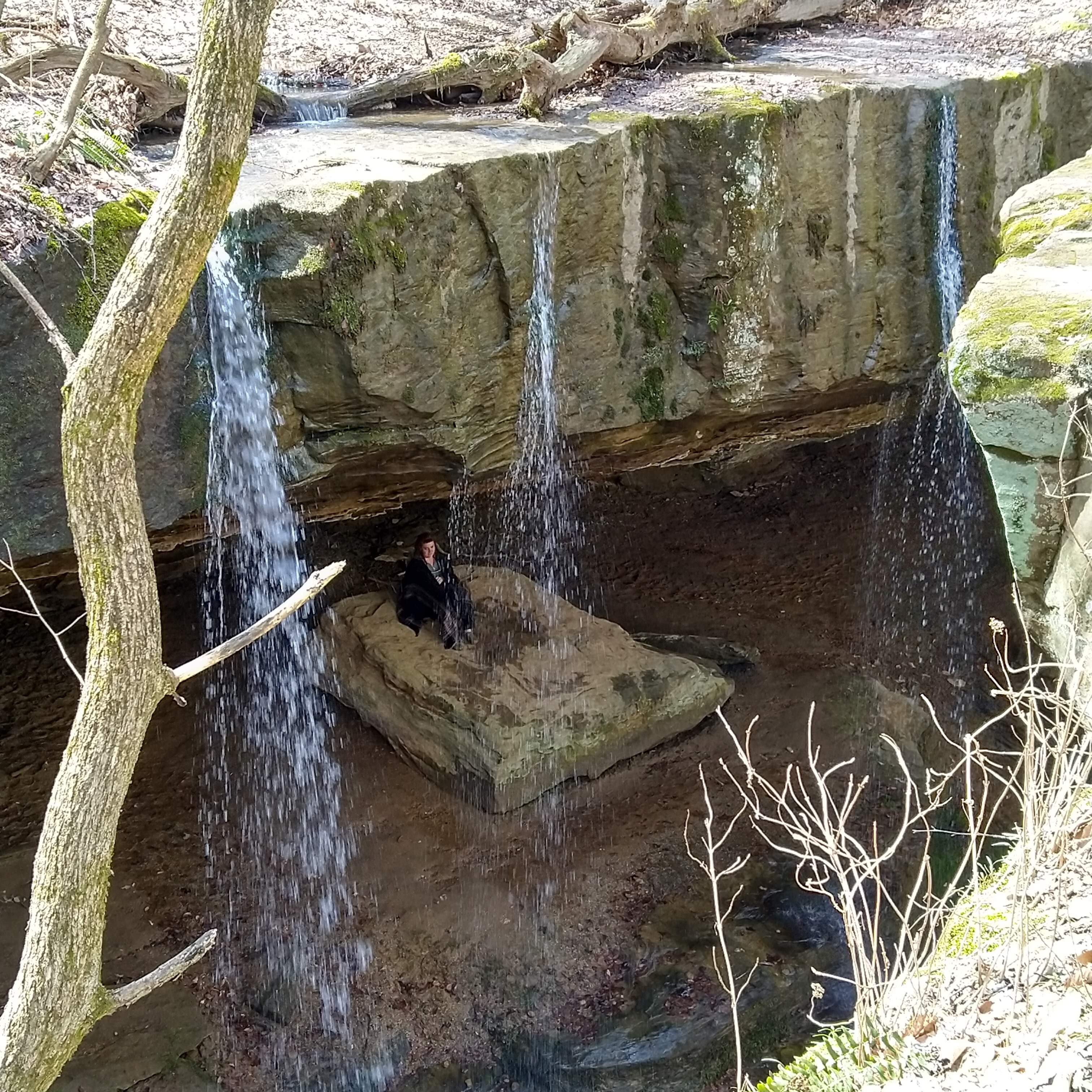
Clifton Gorge is in west-central Ohio. In southeast Ohio, instead you have hollows, with somewhat shallower waterways, wider riverbeds, and less sheer cliffs. But from what I could tell while walking the short loop at Wildcat Hollow (top left), the differences are mostly semantic. By forgoing the long loop, we never really got down into the hollow itself, but it seemed deep enough from the top of the tree line (top right). At Boch Hollow, the routes from the west trailhead -- not far from the permit area to visit Robinson Falls (middle left) -- involve plenty of elevation. So much so that, when we stopped for a snack, it felt good to put my boots up (middle right). After a climb out of the valley, we passed through a dormant field on the way back to the parking lot. The mottled clouds in the sky and the snow patches on the ground made it clear that our trek through autumn had ended and we were headed toward winter (bottom).


 ------

BUCHANAN, CHARLES L. “J. FRANCIS MURPHY A POET PAINTER.” Arts & Decoration (1910-1918), vol. 3, no. 6, 1913, pp. 191–193. JSTOR, www.jstor.org/stable/43805824. Accessed 21 June 2021.

Friday, May 28, 2021

"'Where were you when . . .?' is a common script"

Like the Kennedy assassination and the Twin Tower attacks, it's likely that the COVID-19 pandemic will become the "Where were you when ...?" question for a generation. I happened to be in Cumberland, Maryland, as a halfway meet-up for Scott and me. It was intended to be a low-key weekend, including drinks with an old friend, homemade dinners at our AirBnB (left), and some hijinks at the Hooley Pub Crawl (right). I fully expected an unexpected run-in with a former student would be the big surprise of the trip.


But by Saturday morning, announcements about scaling back the St. Patrick's Day party were made. For better or worse, we decided to still participate, although we kept our distance at most places, including Dig Deep Brewing Co. (left). But by the evening, it became apparent that perhaps we should take more precautions, so the next day, we put some real space between ourselves and the world by hiking the lakeside loop at Rocky Gap State Park (right). We finished the 5 miles at the casino contained in the park. Its slot machines were shockingly silent and its bars eerily empty. Employees told us they were being sent home soon. (Incidentally, I went on a hike and then to a casino on 9/11, too, which is weirdly coincidental for a person who dislikes casinos.) After one last drink in the wild, I headed back home, to DC, as well.


But not long after, upon deciding that holing up alone in my apartment in a shuttered city would probably not be best for my mental health, I headed to Ohio for the long lockdown haul. And with that decision began the now cliched phase called "the new normal," or as I like to call it, based on another trope topic: "What I Did on My Staycation." At first, we spent the short, cold days inside, throwing darts, playing online trivia, and counting the cars lined up for the DQ drive-thru (top left). On those only-in-Ohio surprise summer-like respites, we rushed to the local baseball field for some bocce competition (top right). We Zoomed into a Seder celebration (bottom left) but had a simple meal by tablelight for Easter (bottom right).


When the shutdown stir crazies set in, we set out on hikes. Our first foray was to Rockbridge State Nature Preserve because nearby Hocking Hills State Park was so inundated that it was made off-limits to visitors (top left). Another adjacent alternative were the nearly empty trails through Zaleski State Forest (top right). Sometimes, we stayed a little closer to home, enjoying the wildflowers at Stage's Pond State Nature Preserve (bottom left) or hunting for geocaches at Slate Run Metro Park (bottom right).


As the weather warmed, weekend hikes turned into daily walks, occasionally on the small trails near the Bergstresser/Dietz Covered Bridge, the last standing covered bridge in Franklin County. Running under this bridge is Little Walnut Creek, where we canoed twice when the water level was high enough (top left). Another weekend, we got into the flow at Darby Creek (top right), and a few times, we paddled into the middle of Hargus Lake to take a dip. One time, we got off the couch and out with SOFA (Southern Ohio Floaters Association) for an excursion at Paint Creek State Park (middle). At one point, we pulled out of the lake for lunch and a short hike up a creek (bottom left). Our destination was a small cave system, a veritable adult jungle gym complete with bats (bottom right).


Before we paddled, we pedaled, in Athens. We rode the trail from The Plains into town, so I could set eyes on my alma mater (top). On the way back, we stopped by a few trailside breweries to pick up some growlers, but not before I tried to get a refund on my mispent youth by visiting my former houses: one on Mill Street, where a big, friendly doggy now lives (bottom left), and another on Kern Street, where I long ago left my permanent mark on the sidewalk out front (bottom right).


For my birthday, we traded pedal power for horsepower for a trail ride near Athens, led by Uncle Buck's Riding Stable (top left). Despite my enthusiasm, I (and my butt) happily opted against the longer trip to Moonville Tunnel (top right). It was more than enough to just be out amid the tranquility of tall trees (bottom left). It's just too bad the stable's saloon wasn't open for business (bottom right), so there was no opportunity for some refreshment while we re-engaged our legs.  


Instead, we headed to horse-themed Rockmill Brewery, which previously was the location of our first post-lockdown outing (top left). The beer is great, but the setting is equally spectacular. Its property edges up against the Hocking River (top right), which flows down from the Rock Mill that gave the former farm its name. By a bend in the river sits a small chapel, which hosts weddings but is also the backdrop for a live music series (bottom left) that lets you bask in some tunes as the sun goes down (bottom right).


Most of the time we managed to spread out, but we made space for our bar trivia bubble (left). Due to an unfortunate series of events, we had to give up on our regular haunt. Luckily, the U.S. flagship of BrewDog is within walking distance, so we started heading there for trivia instead (right). (Don't be alarmed by the fire truck; the situation was taken care of and we safely returned to our suds.) So basically, besides hiking, canoeing, biking, and horseback riding, I used my vacation to earn free beer with random facts from my brain. Or in other words, to turn a new but now common phrase: I gained the "quarantine 15," just like everyone else


------

Adams, Rebecca G., and Rosemary Blieszner. “Baby Boomer Friendships.” Generations: Journal of the American Society on Aging, vol. 22, no. 1, 1998, pp. 70–75. JSTOR, www.jstor.org/stable/44875682. Accessed 18 May 2021.